Study

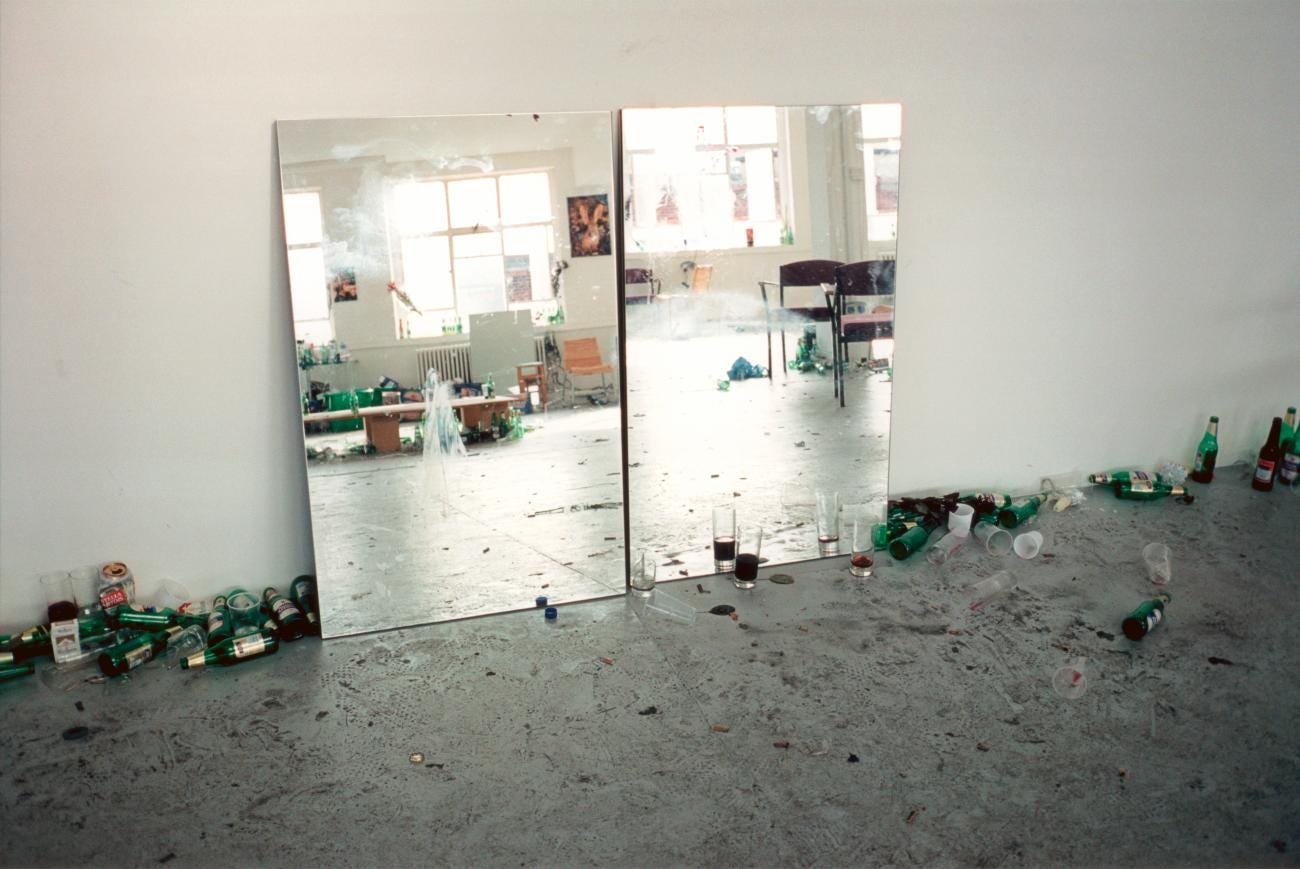
The etymology of the word studio has its many roots, which have become somewhat entangled by modern language. First noted in 1819, studio was the “work-room of a sculptor or painter,” usually one with windows to admit light from the sky. This was stolen from the Italian studio “room for study”, in turn a borrowed word from the Latin studium - “study, apply oneself, show zeal for; examine”, originally “eagerness,” from studere “to be diligent”. The latter s-teu reconstructed to mean “to push, stick, knock, beat”. The notion appears to be “pressing forward, thrusting toward,” hence “striving after.”
The residual smell of star anise, cinnamon and cloves.
Five bouquets of flowers, propped up in the sink in a measuring jug to keep them alive: testament of love.
The idea of study: somehow not dissimilar to beating the world with a stick.
For Moten and Harney, ‘study’ is interested in the notion of a rehearsal which resonates in the wider activities of my life. Over the summer, I sat in the kitchen of my childhood home and languished in the enraptured audience as I read aloud to my friends. In the spring, the speculative practice of dancing with other people, creating spaces in which connections are forged between people, small intimacies and solidarities. At the pub, I read a friends writing and offer feedback. We create alliances against the ever-consuming speed and seduction of capital accumulation and dance the night away. This here is the undercommon, my little industrial estate where we work side by side, where we dance together and drink together, where we mop and we scrub, where we take drugs, where I’ve been known to have a nap and a hot chocolate. Andy calls the studio my creative habitat and I enjoy the metaphor, which implies a symbiosis and ease – I am nothing more than a little creature.
Is there a way to be in the undercommons that isn’t intellectual? Is there a way of being intellectual that isn’t social?
In an exhibition at the studio, I title all of my works with texts received from ex-boyfriends: “Hope the hibernation has been/is fecund”, “being apart and missing somebody is simple business”, Where are you floating atm?”
When I think about the way we were using the term ‘study,’ I think we were committed to the idea that study is what you do with other people. It’s talking and walking around with other people, working, dancing, suffering, some irreducible convergence of all three, held under the name of speculative practice. The notion of a rehearsal – being in a kind of workshop, playing in a band, in a jam session, or old men sitting on a porch, or people working together in a factory – there are these various modes of activity.
I draw upon Deleuze and Guattari’s concept of the contingent assemblage, to position the artist studio as a material-conceptual coming together of diverse parts, including human bodies, non-human objects, language, technology and ideas. This concept is useful in a threefold way: Firstly, the assemblage is concerned with heterogeneity and therefore allows us to consider the many disparate parts or ‘blocks’ which make up the studio. Secondly, the contingent assemblage is concerned with territorialization and de-territorialization, or the process by which temporary identity is stabilised and homogenized, as well as unmade and re-made in response to changing behaviours and acting forces. Particularly in the context of the precarious temporality of contemporary artist studios, this is helpful in understanding how spaces and territories are occupied and stabilised in the short term, and the effects of spatial displacement, as artists vacate and take up occupancy elsewhere. Lastly, I draw upon the assemblage to position the artist studio as a productive reality; rooted in the material world, with the agency to generate new behaviours, expressions and affects.
Limazula/Ran/Mezzanine/Calcio/Zona Mista/Bibliothequa/Kunst Affair/Magick/Venue MOT/Ormside/Avalon: this argonaught ship of organisations, people, objects, affects.
The point of calling it ‘study’ is to mark that the incessant and irreversible intellectuality of these activities was already there. These activities aren’t ennobled by the fact that we now say, ‘oh, if you did these things in a certain way, you could be said to be have been studying.’ To do these things is to be involved in a kind of common intellectual practice.
Back in London, the studio is under threat. I am suddenly soberly aware of the increasing criminalisation of our activities. Much loved venues close, and the narrow window of temporality closes further. In the early days of my party life, I was emboldened by a euphoria which had a utopian politics which came with its altered state. I believed in the counterculture.
Carl texts me: There’s something in Barthes about annihilation and love. I forget what exactly
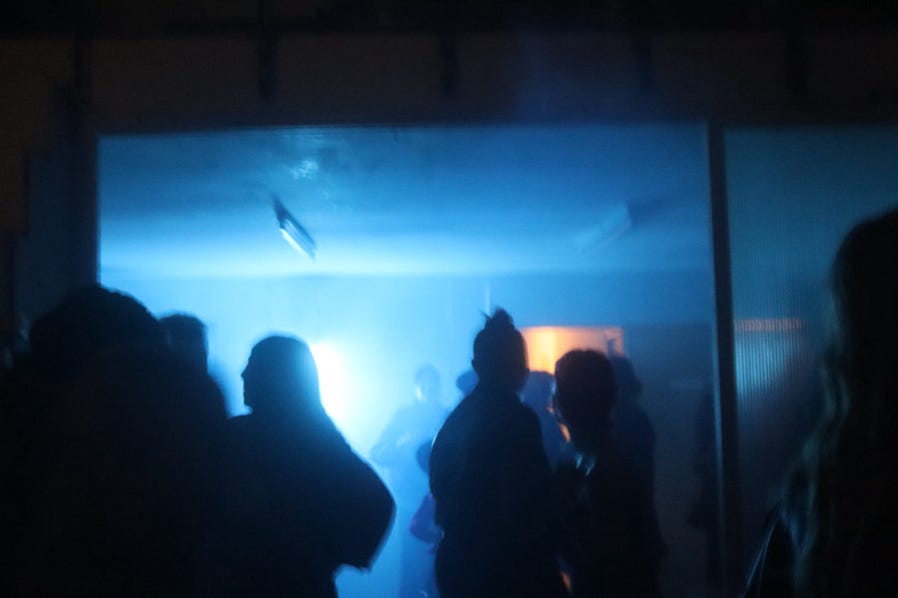
I throw my head back I laughter. I wash it down with warm beer. The feeling of the music which permeates the edges of the body. Sound is promiscuous, working on my body, on yours, on everyone in the room – infiltrating, touching, vibrating. Restlessness sends me straight to the dancefloor, shoulders side to side, hips swing. Bodies pressed against on another. I’m aggravated by the slight touch of fingers, a person steps backwards into me. My attention to my bodily sensations makes me easily irritated. I manoeuvre myself in the crowd to the front left where space is slightly more open. I am able to stretch my wrists further, then curl them in time with the beat. This is a gesture which I learnt from my mother - slightly orientalist in style - but it feels good and the music is all about releasing impulses. Shoulders, hips. I find a good movement and repeat it over and over again – this is the joy of a repetitive beat. The feeling of heat. I pause to pull my hair from my face and tightly secure it at the pack of my neck, allowing a little more coolness to settle between my shoulders. Rising change to the music, a female vocalist - my not-so-secret pleasure – 90’s house, always – a little bit acid, a little bit disco, medium-high bpm. Now we’re in it. Friend faces me and we experience a flash of shared joy, but mostly my eyes are shut and I am content with knowing their body is moving next to mine, content with finding the right reverberating rhythm which nestles in my ribcage at just the right height – high enough not to upset my tummy, low enough to not interfere with my heart. Its catching, a beat so good I could cry. Hell yeah. Brain empties out. Just left right, left, right, left, right, left, right, right. Break the pattern, twist, find a new one.
Call me utopian, but these socialites of my day-to-day are studious. Play and experimentation, materio-conceptual speculative practice.
Working, dancing, suffering, some irreducible convergence of all three.
*
NB: Unless otherwise attributed, all quotes are from The Undercommons: Fugitive Planning and Black Study by Fred Moten and Stefano Harney